



Raspberry Pi 5
Raspberry Pi 5 Model B – BCM2712 Quad-Core Cortex-A76 @ 2.4GHz | Up to 16GB LPDDR4X | PCIe 2.0 | Dual 4K HDMI The Raspberry Pi 5 Model B is...
Read MoreSKU:RPI039
- Regular price
- Rs. 5,209.00
- Sale price
- Rs. 5,209.00
- Regular price
-
Express Shipping
Shipping Info
Fast delivery options for your convenience
Pick-Up in Store
Free
Select this option to pick up your order directly from our store. Fast and convenient!
Raspberry Pi 5 Model B – BCM2712 Quad-Core Cortex-A76 @ 2.4GHz | Up to 16GB LPDDR4X | PCIe 2.0 | Dual 4K HDMI
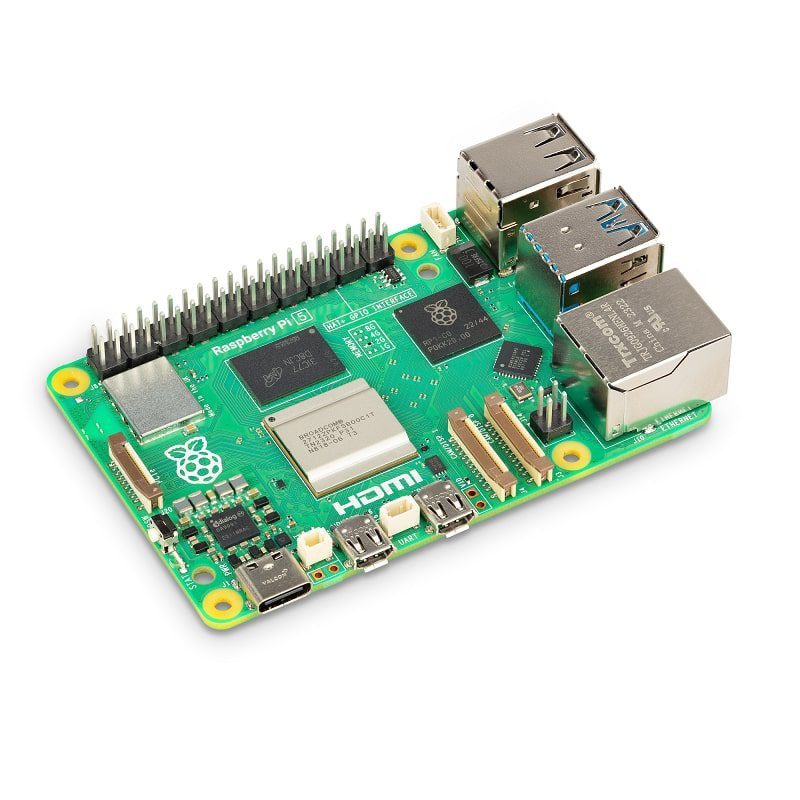
The Raspberry Pi 5 Model B is the most powerful single-board computer Raspberry Pi has ever built — delivering 2–3× the performance of Raspberry Pi 4 in real-world workloads. Powered by the new Broadcom BCM2712 quad-core Cortex-A76 processor at 2.4GHz, featuring a dedicated RP1 southbridge I/O chip and up to 16GB LPDDR4X-4267 RAM, it introduces the first-ever PCIe 2.0 interface on a Raspberry Pi for NVMe SSD expansion, a built-in real-time clock (RTC), and significantly improved USB, camera, and display performance. Whether you're deploying edge AI, building robotics systems, running a home server, or learning embedded Linux — the Raspberry Pi 5 is the definitive platform for serious makers and engineers.
Why the Raspberry Pi 5 Is a Major Leap Forward
The Raspberry Pi 5 isn't just a spec bump — it's a ground-up redesign. The new RP1 southbridge chip offloads all I/O (USB, camera, GPIO, Ethernet) from the main SoC, giving each subsystem dedicated bandwidth and eliminating the bottlenecks that limited the Pi 4. The result is a board that can run two 4K displays, stream from cameras, serve USB 3.0 devices, and process GPIO — all simultaneously, without performance compromise.
Key Features at a Glance
- BCM2712 Quad-Core Cortex-A76 @ 2.4GHz — 512KB per-core L2 cache + 2MB shared L3; 2–3× faster than Pi 4
- VideoCore VII GPU @ 800MHz — OpenGL ES 3.1 and Vulkan 1.2 (Vulkan 1.3 via Mesa); ~3× GPU performance vs Pi 4
- 1GB / 2GB / 4GB / 8GB / 16GB LPDDR4X-4267 — up to ~30,000 MB/s memory bandwidth (5–6× faster than Pi 4)
- PCIe 2.0 FPC Interface — connect NVMe SSDs (via M.2 HAT+), AI accelerators (Hailo-8L), and custom peripherals
- Dual 4K @ 60Hz Micro HDMI with HDR — drive two independent 4K displays simultaneously
- Gigabit Ethernet + Dual-Band 802.11ac Wi-Fi + Bluetooth 5.0 / BLE — full wired and wireless connectivity
- 2× USB 3.0 (5 Gbps each) + 2× USB 2.0 — simultaneous high-speed peripheral support
- 40-Pin GPIO Header — backward-compatible with Raspberry Pi HATs and accessories
- 2× 4-Lane MIPI CSI / DSI Connectors — camera and display interfaces; supports dual-camera setups
- MicroSD Slot (SDR104 / DDR50) — faster SD bus for quicker boot and I/O; pair with NVMe for maximum speed
- Built-in Real-Time Clock (RTC) — battery-backed timekeeping; timed wake-up from powered-off state
- USB-C Power (5V / 5A, 27W) — USB PD detection; official PSU recommended for full peripheral power
- RP1 Southbridge I/O Controller — dedicated I/O chip eliminates USB/camera/GPIO bandwidth contention
Real-World Performance vs Raspberry Pi 4
| Benchmark / Task | Raspberry Pi 5 | Raspberry Pi 4 |
| Single-Core Performance | ~2–2.5× faster | Baseline |
| Multi-Core Performance | ~2–3× faster | Baseline |
| Memory Bandwidth | ~30,000 MB/s | ~4,000–6,000 MB/s |
| Web Browsing (Speedometer 2.1) | ~3× faster | Baseline |
| File Compression (bzip2) | ~2× faster | Baseline |
| GPU Frame Rate (OpenArena) | ~3× faster | Baseline |
| Wi-Fi Throughput | ~3× faster | Baseline |
Ideal Applications
- Edge AI & Machine Learning — run TensorFlow Lite, ONNX Runtime, and Hailo-8L models for real-time object detection, classification, and NLP at the edge
- Robotics & Autonomous Systems — real-time sensor fusion, motor control, and vision processing with direct GPIO and camera interfaces
- Computer Vision — dual CSI camera support with hardware-accelerated image signal processing for industrial inspection and surveillance
- Desktop Replacement — full 64-bit Linux desktop with dual 4K HDMI for a capable everyday workstation or coding environment
- Home Server / NAS — pair PCIe 2.0 with an NVMe SSD for a fast home network-attached storage or media server
- Industrial IoT Gateway — Gigabit Ethernet + dual-band Wi-Fi for reliable, always-on industrial data collection and edge processing
- Media Center / HTPC — 4Kp60 HDR decode for smooth multimedia playback via Kodi or VLC
- STEM Education & Research — comprehensive GPIO, I2C, SPI, UART interfaces for teaching electronics, embedded systems, and software engineering
- Network Functions (VPN, Pi-hole, DNS) — Gigabit Ethernet makes Pi 5 an excellent low-power network appliance
- Software-Defined Radio (SDR) — USB 3.0 bandwidth and fast processing for RTL-SDR, HackRF, and signal analysis projects
Technical Specifications
| Feature | Specification |
| Processor | Broadcom BCM2712 — Quad-Core Arm Cortex-A76 (ARMv8.2-A) 64-bit @ 2.4GHz |
| Cache | 512KB per-core L2 + 2MB shared L3 |
| GPU | VideoCore VII @ 800MHz — OpenGL ES 3.1, Vulkan 1.2 (Vulkan 1.3 via Mesa 24.3+) |
| I/O Controller | RP1 Southbridge (dedicated I/O chip for USB, Ethernet, camera, GPIO) |
| RAM Options | 1GB / 2GB / 4GB / 8GB / 16GB LPDDR4X-4267 SDRAM |
| Storage | MicroSD slot (SDXC, SDR104/DDR50, up to 2TB); NVMe via PCIe 2.0 |
| PCIe | PCIe 2.0 x1 FPC connector — M.2 HAT+, NVMe SSDs, AI accelerators |
| Display Output | 2× Micro HDMI — up to 4K @ 60Hz per port, HDR support |
| Networking | Gigabit Ethernet (BCM54213) · Dual-Band 802.11ac Wi-Fi · Bluetooth 5.0 / BLE (CYW43455) |
| USB Ports | 2× USB 3.0 (5 Gbps each) + 2× USB 2.0 (480 Mbps) |
| GPIO | 40-pin header (2.54mm pitch) — compatible with existing Pi HATs |
| Camera / Display | 2× 4-Lane MIPI CSI/DSI connectors (22-pin, 0.5mm pitch) — bi-directional, dual camera support |
| Real-Time Clock | Integrated RTC (32kHz crystal, 50ppm) — supports battery backup & timed power-on |
| Power Input | USB-C with USB PD — 5V / 5A (27W recommended); minimum 5V / 3A for basic use |
| Power Consumption | Idle: ~8–9.5W · Peak: ~12W (under full CPU + USB load) |
| OS Support | Raspberry Pi OS (Bookworm+), Ubuntu 24.04 LTS / 25.04, Armbian, Kali Linux, DietPi |
| Operating Temperature | −20°C to +70°C (active cooling recommended above 80°C throttle threshold) |
| Board Dimensions | 85.6mm × 56.5mm |
| Cooling | Active cooling required for sustained performance (throttles at 80°C; idles ~65°C without cooling) |
What's in the Box
- 1× Raspberry Pi 5 Model B (as per selected RAM variant)
Note: MicroSD card, power supply, case, and cooling are not included. The official Raspberry Pi 27W USB-C PD Power Supply is strongly recommended — a standard phone charger will reduce USB port power budget and may limit peripheral performance. Pi 4 cases and DSI/CSI cables are not compatible due to repositioned connectors; use Pi 5-specific enclosures and adapters.
Recommended Accessories
- Power Supply: Official Raspberry Pi 27W USB-C PD Supply (5.1V / 5A) — required for full performance and full USB port power
- Storage: MicroSD card (Class 10, U3, V30, A2 rated) — 64GB or larger recommended; or NVMe SSD via M.2 HAT+
- Cooling: Official Raspberry Pi Active Cooler or Pimoroni Fan SHIM — essential for sustained CPU workloads
- Case: Official Raspberry Pi 5 Case or compatible Pi 5 enclosure (Pi 4 cases do not fit)
- Display Cable: Micro HDMI to HDMI cable (sold separately)
- Camera: Raspberry Pi Camera Module 3 — requires 22-pin to 15-pin FPC adapter cable (included with Camera Module 3)
Frequently Asked Questions
Which power supply do I need for the Raspberry Pi 5?
The official Raspberry Pi 27W USB-C PD Power Supply (5V / 5A) is strongly recommended. If a USB-C charger without Power Delivery negotiation is used, the Pi 5 enters a compatibility mode that limits each USB port to 600mA (versus 1.6A per port with the official PSU). For basic desktop use a 5V / 3A (15W) supply will work, but you may see under-voltage warnings under heavy peripheral loads.
Does the Raspberry Pi 5 need active cooling?
Yes, for sustained workloads. Without cooling, the Pi 5 idles around 65°C and starts throttling at 80°C. With the official active cooler or a quality fan, temperatures stay around 50–55°C under full load indefinitely. Passive cooling alone is generally not sufficient for AI inference, video encoding, or other CPU-intensive tasks.
Is the Raspberry Pi 5 backward compatible with Pi 4 accessories?
Partially. The 40-pin GPIO header maintains the same pinout for HATs, though some software changes may be needed. However, Pi 4 cases do not physically fit due to repositioned connectors and the new power button. The CSI and DSI connectors are now 22-pin / 0.5mm pitch (smaller than Pi 4's 15-pin), so existing camera and display ribbons need an adapter cable.
Can I use an NVMe SSD with the Raspberry Pi 5?
Yes. The Pi 5's PCIe 2.0 x1 FPC connector supports NVMe SSDs via the official M.2 HAT+ or compatible third-party adapters. NVMe storage is significantly faster than MicroSD and is recommended for OS boot, databases, and high-throughput applications. PCIe Gen 3 speeds are not officially certified and may be unstable.
How much faster is the Pi 5 compared to the Pi 4?
In real-world benchmarks: 2–3× faster CPU performance, ~3× faster web browsing, ~2× faster file compression, ~3× faster GPU performance, and 5–6× higher memory bandwidth. The Pi 5 also brings a completely re-engineered I/O stack via the RP1 chip, which alone eliminates many bandwidth bottlenecks that existed in Pi 4.
What is the RP1 chip and why does it matter?
The RP1 is a custom southbridge I/O controller designed by Raspberry Pi Ltd. In previous models, all I/O shared bandwidth through the main SoC's USB 3.0 hub. The RP1 gives USB, Ethernet, camera pipelines, and GPIO their own dedicated pathways — meaning you can stream from two cameras, serve USB 3.0 devices, and run GPIO peripherals simultaneously without any one subsystem starving the others.
What is the built-in real-time clock (RTC) used for?
The Pi 5 includes an integrated RTC backed by a 32kHz crystal oscillator. With a small coin-cell battery connected to the RTC header, the Pi can maintain accurate time even while powered off — useful for offline data loggers, remote cameras, and industrial sensors. The RTC also enables timed power-on wake-up, allowing the Pi to boot at a scheduled time without external intervention.
What operating systems are supported?
Raspberry Pi OS (Bookworm, 64-bit) is the primary and best-supported OS. Other options include Ubuntu Desktop and Server 24.04 LTS / 25.04, Armbian, DietPi, Kali Linux, and various community distributions. A 64-bit OS is strongly recommended to take full advantage of the Cortex-A76 architecture and available RAM above 4GB.
Which RAM variant should I choose?
4GB is the best choice for most users — ample for desktop use, robotics projects, and light AI workloads. 8GB is recommended for running multiple applications simultaneously, heavier AI inference, or compiling large software. 16GB suits memory-intensive server workloads, large language model inference, or running several containers simultaneously. The 2GB variant is suitable for dedicated, single-task appliances (Pi-hole, VPN, sensors).
Does the Pi 5 support Wi-Fi 6 or Ethernet PoE?
The Pi 5 uses dual-band 802.11ac (Wi-Fi 5), not Wi-Fi 6. Wi-Fi throughput is approximately 3× faster than Pi 4 due to an improved SDIO interface. Power over Ethernet (PoE+) is supported via a compatible PoE+ HAT (sold separately); it is not built in.
Can the Raspberry Pi 5 run AI and machine learning workloads?
Yes. The Pi 5 runs TensorFlow Lite, ONNX Runtime, and PyTorch (ARM builds) natively. For significantly accelerated inference, the Raspberry Pi AI Kit adds a Hailo-8L NPU (13 TOPS) via the PCIe interface, enabling real-time object detection at 30+ FPS. Google Coral USB Accelerator is also compatible via USB 3.0.
Note: MicroSD card, power supply, case, cooling, and display cables are not included. The official 27W USB-C PD Power Supply is strongly recommended for full performance and maximum USB port power.